

Care pathways
Facing a cranio-maxillo-facial malformation means embarking on a long and complex journey that involves the patient and the whole family.
In the Smile House Model, care is much more than a set of medical treatments: it is continuous, human and professional support that begins even before birth and continues until the person’s complete psychophysical development. It is the concrete answer to one of the great challenges of the healthcare system: offering not only effective treatment, but ongoing, personalised guidance that provides a coordinated response to needs that change over time.
Find out more about our model of care:
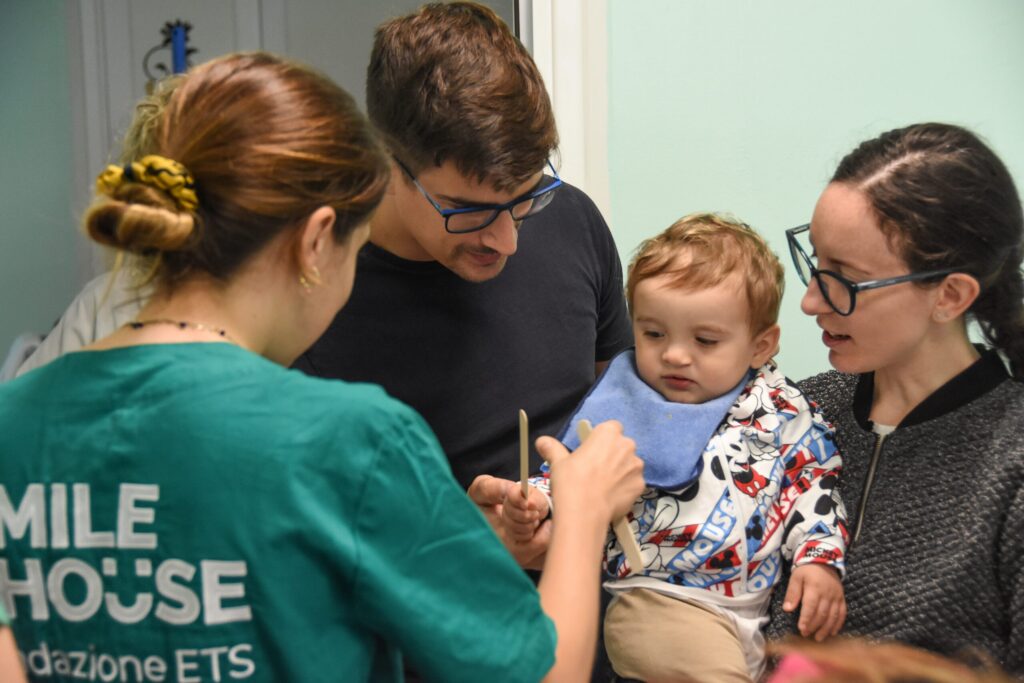
Territorial coverage
Territorial coverage is one of the cornerstones of the Smile House Model: it means guaranteeing every patient access to excellent specialist care without having to bear the burden of health migration.
In partnership with the Ministry of Health and in synergy with the National Health Service, we have created an integrated national network now made up of eight Smile House Centres: outpatient and surgical facilities located within public hospitals, with which they share resources and expertise.
Our system is based on the Hub & Spoke model:
- Hub Centres (Rome, Vicenza, Pisa, Monza): reference centres where primary surgical procedures and the most complex multi-specialist activities are concentrated. Concentrating clinical cases (estimated at around 700 new patients a year in Italy) is essential to guarantee high safety standards and to support training and scientific research.
- Spoke Centres (Cagliari, Taranto, Ancona, Catania): outpatient centres that ensure continuity of care across the territory, providing complementary treatments, monitoring and follow-up.
Why does this distinction matter?
Travelling a few times to a Hub Centre for the 4 or 5 necessary surgical procedures is one thing; having to travel out of the region every month for frequent treatments such as orthodontics or speech therapy is quite another. Thanks to our Spoke Centres, we are able to bring this specialist care into the patient’s everyday life.
Our model has a dual value:
- clinical and care-related, because it guarantees quality, continuity and proximity of care;
- social and economic, because it makes a concrete contribution to tackling health migration, while at the same time making the most of local resources and expertise.
Multidisciplinary approach
The multidisciplinary approach guarantees the coordinated and continuous involvement of an integrated specialist team made up of maxillofacial surgeons, orthodontists, speech and language therapists, psychologists, ear, nose and throat specialists, geneticists and other healthcare and social care professionals. Specialists step in according to the specific needs of each patient and work together to ensure the highest quality at every stage.
- Surgery: the initial focus of the pathway, aiming to restore facial function and harmony through procedures scheduled according to the patient’s age and the complexity of the malformation. It begins with the main procedure in the first months of life, followed by secondary and corrective procedures throughout childhood; in adolescence and adulthood, further procedures are carried out to harmonise aesthetics and function.
- Orthodontics: an activity that starts early, from the first days of life, and accompanies the patient throughout their growth. It initially aims to reduce the extent of the malformation and support correct feeding, then to guide the development of the dental arches and the bone structures of the face, and to prepare the patient for any future procedures.
- Speech therapy: essential from early infancy, it aims to support the development of oral functions such as sucking and swallowing, breathing and language development. The long-term goal is to strengthen verbal communication and facilitate integration at school and in society.
- Psychology: personalised psychological support for the child and their family, provided throughout the entire care pathway, from prenatal diagnosis to adulthood. It aims to help the family come to terms with the diagnosis and its implications, supporting emotional processing, bolstering self-esteem and accompanying the patient through the most delicate developmental stages, such as starting school or adolescence.
- Ear, nose and throat (ENT): a crucial role in monitoring and managing hearing problems and upper airway issues. Early and continuous intervention is essential to prevent difficulties that could compromise language and communication development.
- Genetics: essential counselling from the prenatal stage onwards, to identify any associated syndromes and provide clear information on the expected clinical picture and the risk of recurrence in any future pregnancies. As well as contributing to the planning of the treatment pathway, it can also help guide clinical research and the personalisation of care.
Continuity of care
In the Smile House Model, care is a structured and continuous pathway that unfolds across various stages of the patient’s life, from prenatal diagnosis through to adulthood, ensuring comprehensive and lasting care.
These are the main stages of the care pathway envisaged by our model:
-
Prenatal phase
We welcome parents immediately after diagnosis, providing emotional support, clinical information and guidance.
This phase also includes:
- Genetic counselling;
- Psychological counselling.
-
Neonatal phase

In the first months of the child’s life, we carry out the first surgical operation on the lip (cleft lip): the aim is to restore functionality and reduce the aesthetic impact.
This phase also includes:
- Preparation for surgery;
- Psychological support for parents;
- Nutritional counselling.
-
Early childhood

At this stage we treat the cleft palate and, if necessary, carry out revisions of the lip or nose.
This phase also includes:
- Speech therapy treatment;
- Ear, nose and throat consultation.
-
Childhood

This is the time for functional consolidation: we carry out secondary operations to improve speech function and aesthetics, while introducing rehabilitation and orthodontic programmes.
This phase also includes:
- Intensive speech therapy;
- Early orthodontic treatment;
- Psychological support for parents and patient.
-
Adolescence

We focus on bone maturation and facial aesthetics, operating on the nose. At the same time, we intensify psychological support during this delicate developmental stage.
This phase also includes:
- Advanced orthodontics;
- Ongoing psychological support.
-
Adulthood

We complete the care pathway with orthognathic surgery to correct any remaining malocclusions and perfect the aesthetics, promoting full social integration.
This phase also includes:
- Final orthodontic treatment;
- Psychological support.