

The conditions: craniofacial malformations
Craniofacial malformations are structural and functional defects present at birth that affect the face and skull. Although they can impact vital functions such as breathing, feeding and speech, today medicine makes it possible to address these challenges with excellent care pathways that give children, and their future adult selves, a full and serene life.
Cleft lip and palate, the most common malformation
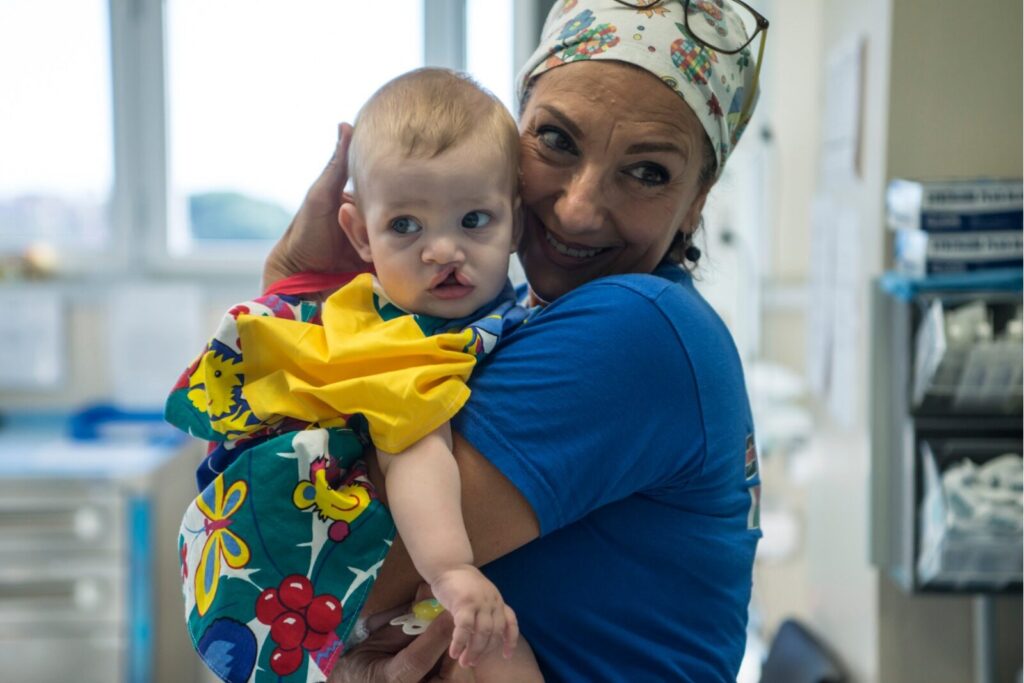
Cleft lip and palate affects around 1 in every 800 newborns in Italy, around 1 in 1,000 newborns worldwide, and in some countries, such as India, the incidence is even higher (up to 1 in 400 newborns).
It occurs in the early weeks of pregnancy (between the fourth and twelfth week), when the parts of the lip or palate fail to join correctly during the development of the foetus.
The different forms of cleft
Every case is unique, since the failure of the parts to join (the cleft, precisely) can affect one or more structures: the upper lip, the upper dental arch (known as the alveolar process), the hard palate (the bony part) or the soft palate (the rear part, with muscles and uvula).
Clefts are divided into three types:
Cleft lip
Commonly known as a hare lip, it affects only the upper lip. It can present in a mild or more complex form, with a separation that also involves the nose and, at times, the dental arch. It can affect one side only (unilateral) or both sides of the lip (bilateral).
Cleft palate
It is an opening in the palate that can involve the soft palate (the rear part with the muscles and uvula), the hard palate (the bony part) or both. There are also forms known as submucous, where the palate appears intact but the underlying muscles are not joined; these forms are often diagnosed later, when difficulties with speech or feeding emerge.
Cleft lip and palate
When the cleft affects all the structures mentioned (lip, dental arch, hard palate and soft palate), it is known as cleft lip and palate. In this case too, the malformation can occur on one side only (unilateral) or on both (bilateral), with complete or incomplete involvement of the structures.
In many cases the cleft is the only anomaly found in the child (isolated form), but it can also occur as part of broader syndromic conditions involving other organs, such as the heart or kidneys.
Complex craniofacial malformations
Craniofacial malformations are a broad group of conditions present from birth that affect the development of the bones of the skull and face. They can affect fundamental functions such as thought and learning, the senses, breathing, speech, swallowing and chewing, and have a profound impact on self-image and social life.
They are usually divided into five main specialist groups:
Craniosynostosis
This occurs when one or more of the skull’s sutures close too early, before the brain has finished developing. This can alter the shape of the head and, in some cases, cause an increase in intracranial pressure.
The most common forms are trigonocephaly (ridged forehead), plagiocephaly (which causes asymmetry) and scaphocephaly (elongated head).
Diagnosis is confirmed through a specialist examination and radiological tests, while remodelling surgery is generally carried out between 6 and 12 months of age.
Craniofacial synostosis
Craniofacial synostosis conditions are genetic disorders affecting the tissue that gives rise to bones and joints. In these cases, certain receptors that regulate growth do not function correctly, leading to abnormal bone development, often with early closure of the sutures of the skull and face.
There are more than 90 different syndromes belonging to the craniofacial synostosis group; the best known are Apert, Crouzon, Pfeiffer, Muenke and Saethre-Chotzen syndromes.
About half have a hereditary origin, passed on by one or both parents, but with manifestations that vary from person to person. Some forms are very severe, while others may go unnoticed.
Diagnosis requires teamwork by various specialists during pregnancy. Treatment is highly personalised and aims to improve both function and facial harmony through state-of-the-art surgical techniques.
Facial and craniofacial clefts
These are rare malformations that appear as interruptions in the soft tissue or bones of the face and skull. They follow the classification devised by surgeon Paul Tessier, who identified 15 variants based on their location relative to the eyes.
As well as their aesthetic impact, these malformations frequently affect eyesight. Treatment often begins as early as the first year of life to reconstruct the soft tissue of the eyelids, cheeks, lips and nose.
First and second branchial arch syndromes
These malformations arise from alterations in the development of the structures of the maxilla, mandible and ear, and can involve both skeletal and soft tissue.
Unilateral forms include hemifacial microsomia (also known as oto-mandibular syndrome) and Goldenhar syndrome; they cause facial asymmetry, but generally no problems with breathing, swallowing, speech or chewing.
Bilateral forms, on the other hand, seriously compromise the morphology of the face and therefore bring with them functional problems of various kinds, sometimes severe; these include Franceschetti syndrome (also known as Treacher Collins syndrome), Nager syndrome and Pierre Robin sequence.
These malformations are often associated with cardiac, renal, skeletal and nervous system anomalies, which is why a multidisciplinary clinical approach is necessary. Here too, treatment is highly personalised and aims to improve both function and facial harmony.
Rare malformations and complex conditions
This group includes a broad and constantly evolving range of conditions that have not yet been precisely classified. Given their complexity, it is essential that they are studied by a highly experienced multidisciplinary team, able to define the most suitable treatment for each individual case.
Why does it happen? Causes and risk factors
Understanding the origin of these malformations helps in approaching the journey with greater awareness.
According to the most recent clinical evidence, a genetic predisposition always underlies these conditions. However, genetics rarely acts alone: it is the interaction between hereditary makeup and certain external risk factors that determines the likelihood of the malformation actually occurring during foetal development.
It is also important to remember that, although the basis is genetic, heritability (that is, direct transmission from a parent) varies depending on the condition: in the case of clefts, for example, it occurs in only one case in five.
The main external factors that can interact with the genetic predisposition are:
- Environmental factors: exposure to radiation, smoking, alcohol, vitamin deficiencies or harmful substances during pregnancy can increase the risk.
- Mother’s health: conditions such as diabetes, pregnancies at an advanced age or the use of certain medications (such as anti-epileptics and corticosteroids) have been associated with these malformations.
- Infections: contracting rubella, toxoplasmosis or chickenpox during pregnancy represents a further risk factor.
- Combined factors: it is often a combination of genetic and environmental factors.
Our goal: reducing the burden of care
Our ultimate aim is not only to address the condition, but to minimise the so-called burden of care: the physical and emotional load that treatment places on the daily life of the patient and their family. We work to ensure therapeutic, surgical and orthodontic pathways that improve quality of life, always fostering the full social integration of every patient, so that they can look to the future with confidence.
Daily challenges and our support for families
Addressing this type of condition means caring for the child’s growth in its entirety, monitoring both functional and emotional aspects.
-
Feeding

In the first few days it can be complex, but it is managed with measures such as the use of special teats and correct positioning during breastfeeding.
At Smile House Centres, babies are never fed by tube.
-
Hearing and speech
We constantly monitor ear health to prevent infections and other issues that could affect hearing.
Since speech can also get off to a slower start, we support families with careful monitoring from the earliest years, so that we can step in at the right moment to best support the articulation of words.
-
Psychology

Emotional and relational wellbeing is very important to us, and it concerns everyone. That is why we offer psychological support to families from the moment of prenatal diagnosis, and we accompany the child throughout their growth, helping them manage their relationship with themselves and with their peers.